
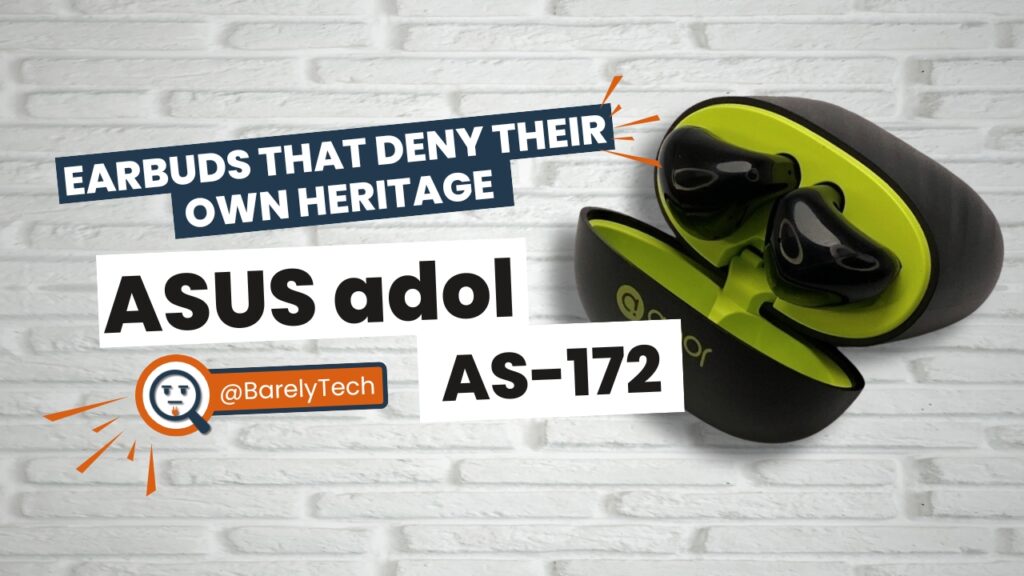
ASUS, typically associated with high-end motherboards and screaming RGB gaming laptops, is an unexpected player in the budget TWS market. The ASUS Adol AS-172 model aims to leverage the brand’s name recognition and tack on “gaming” features to appeal to the cost-conscious mobile user.
These earbuds are clearly designed to be mass-market fodder, but they do offer a surprising set of specifications that, on paper, should make them a contender. Let’s see if they escape the crushing weight of mediocrity.
1. Audio Joy Index
Adol attempts to sell itself on sound quality, even featuring prominent “Deep Bass” claims in its marketing. In reality, the sound profile is textbook budget fare.
It is loud, which counts for something, but it is entirely lacking in depth and definition. Bass is present but flabby, the mids are hollow, and the highs often pierce rather than shimmer. Listening to complex music feels like hearing the orchestra through a cardboard tube. This score reflects that while the sound works for podcasts and basic functional listening, it offers zero enjoyment for anyone who actually likes music.
Score: 2/5
2. Charging Negligence Score
“Boasting” is a strong word for 3.5 hours of runtime, which is bottom-tier for 2025. While the box claims 36 hours total, the math doesn’t add up: the tiny 200mAh case can only physically recharge the 30mAh buds about 2–3 times. Realistically, you’re looking at 10–12 hours total before the case dies—nowhere near the ‘full day’ promised.
This fails to keep pace with modern competitors and means these earbuds will likely die mid-commute. They definitely can’t handle a full day of conference calls without a mid-day top-up. The “36-hour” claim is pure marketing fluff and a major disappointment for anyone expecting actual longevity.
Score: 2/5
3. Pocket Presence Factor
The open-ear clip style is marketed as a comfort revelation, but the lack of a seal means zero sound isolation. Because the 13mm driver sits outside the ear, you suffer from massive sound leakage and an almost total loss of bass impact. The ultra-lightweight feel is a direct result of using cheap, thin plastic that feels more like a generic toy than a tech product.
Score: 2/5
4. Control Usability Score
While the Adol attempts a full suite of touch controls including volume adjustment and voice assistant, the real-world experience is a mess. The manual reveals that volume changes require a triple-tap, while a long-press activates the assistant. In practice, the tiny touch area on these budget shells leads to constant mis-taps. You’ll find yourself accidentally skipping tracks or triggering Siri when you just wanted to turn the music up, making the “Philips-beating” control list look better on paper than in your hand.
Score: 2/5
5. The Wireless Commitment Meter
Marketing pushes the “Asus” name to make the gaming mode sound like a premium ROG feature, but there is nothing “predictable” or “Asus-engineered” about it. This is a generic gaming mode found on the bottom-tier Jerry 6983D2 chipset. While Bluetooth 5.3 is standard for 2025, calling this connection “stable” ignores the reality of budget interference. The specialized mode claims to reduce lag, but don’t expect the 40ms performance of actual ROG gear; you are likely getting 60-100ms, which is still noticeable in any fast-paced competitive game.
While it might help sync up a YouTube video slightly better than standard Bluetooth, it doesn’t magically turn these into a “media powerhouse. You’re paying for a logo on a chip that performs like any cheap earbud.
Score: 2/5
Should you buy it? That’s a hard “No.” The low-latency gaming mode is a budget Jerry-chip gimmick that still leaves a noticeable gap in competitive play. As for conference calls, the tiny 30mAh battery risks cutting you off mid-meeting, and the open-ear design ensures you’ll hear your neighbor’s lawnmower more clearly than your boss.
Overview
Summary
The Asus Adol AS-172 is a masterclass in marketing over substance. By leaning on the Asus name and the trendy ear-clip form factor it masks what is fundamentally a cheap generic product. You are not buying Asus engineering. You are buying a rebranded budget placeholder that fails to hit even the most basic performance benchmarks.